
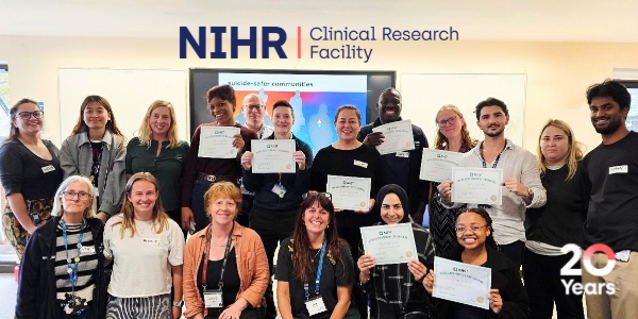
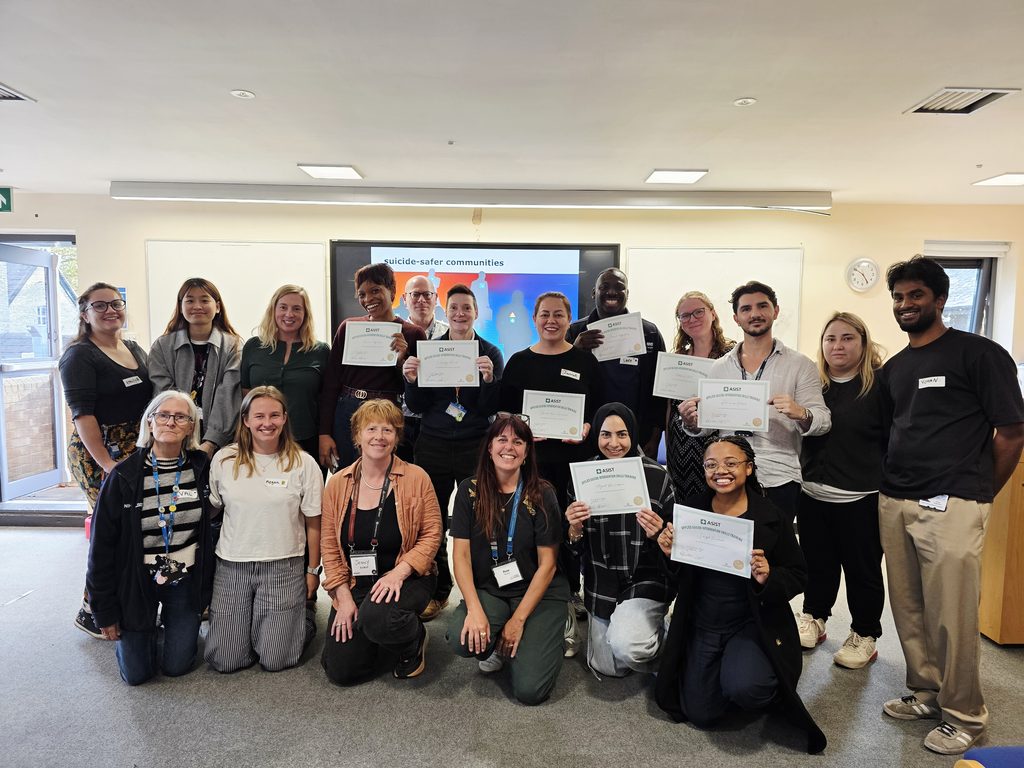
Last week, colleagues from the NIHR Clinical Research Facility (CRF): Oxford Health and Oxford Health NHS Foundation Trust’s Research & Development team completed Applied Suicide Intervention Skills Training (ASIST).
ASIST is a two-day interactive programme designed to help people recognise when someone may be at risk of suicide and respond effectively.
Through discussion, role-play and practical exercises, participants develop the skills and confidence to have direct conversations about suicide, explore immediate safety, and support individuals in connecting with further help.
One of the most powerful aspects of the training is its recognition that suicide prevention is not solely the responsibility of mental health professionals.
Many people experiencing thoughts of suicide first speak, or attempt to speak, to family members, friends, colleagues, neighbours, or members of their local community.
ASIST aims to equip ordinary people with the skills to recognise when someone may be struggling and the confidence to engage in what can be a difficult conversation.
The training places particular emphasis on listening, understanding, and working collaboratively with a person to identify immediate sources of safety and support.
Rather than focusing on theory alone, participants spend time practising realistic scenarios, helping to build confidence in applying these skills when they may be needed.
For those of us working in research, these skills have relevance within our roles. However, the value of ASIST extends well beyond the workplace. At its heart, the programme is about helping to build suicide-safer communities by increasing the number of people who feel able to recognise risk, respond with compassion, and support others in accessing help.

Angela Conlan, CRF: Oxford Health PPIEP Lead, said:
“What struck me most was that ASIST is not about becoming a mental health expert. It’s about giving ordinary people the confidence to recognise when someone may be at risk, start a conversation, and help them find a path to safety.”

Deborah Moll, CRF: Oxford Health Mental Health Team Lead and event organiser said:
“We would like to thank the facilitators, Rose Rowkins and Jenny Pickup for creating a thoughtful, supportive environment in which to engage with a challenging but important subject.
“The experience reinforced an important message: preventing suicide is not about having all the answers. It is about being willing and able to notice when someone may be at risk, start a conversation, and help them find a path to safety.”
Contact [email protected]